Peer Reviewed Articles
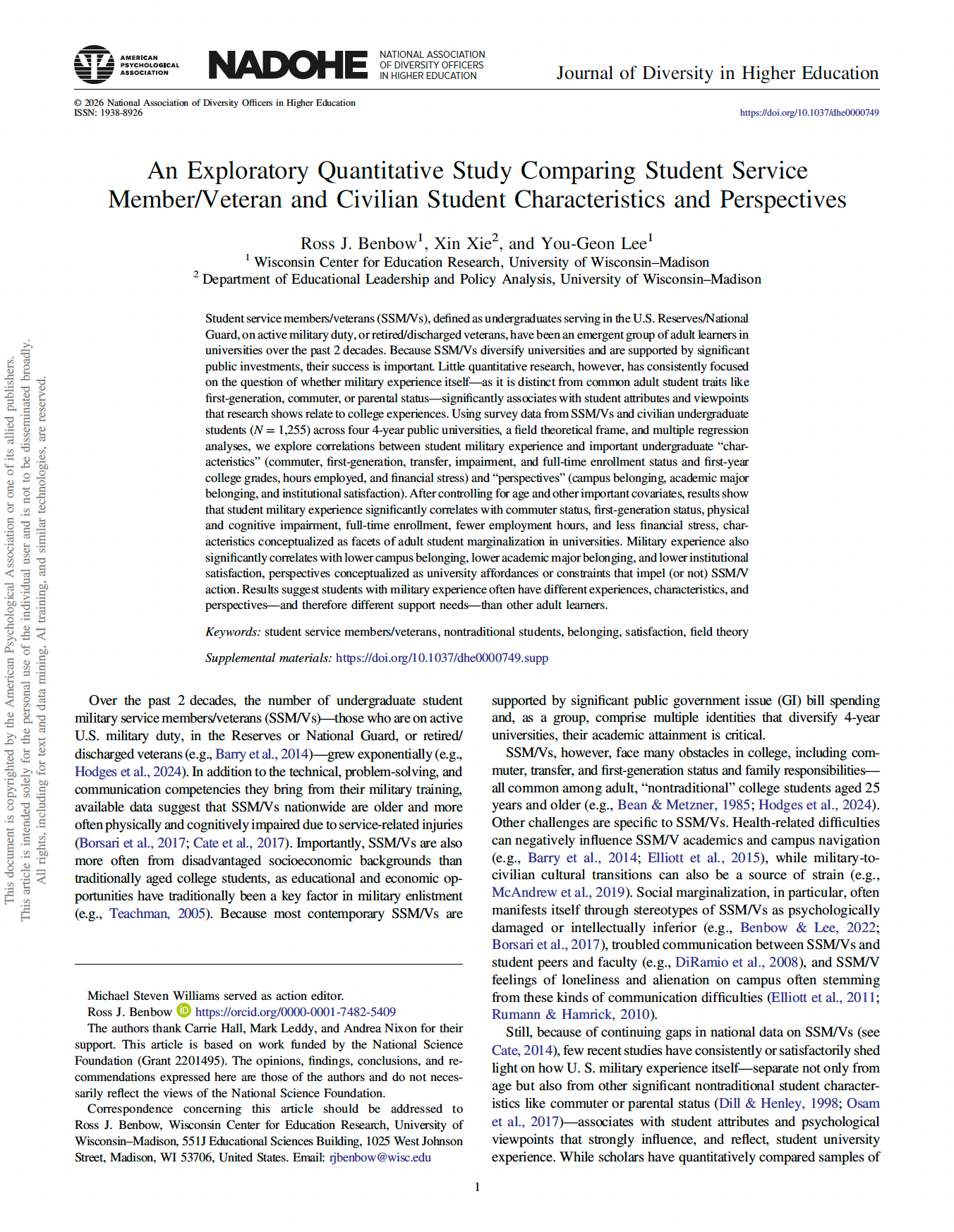
Benbow, R. J., Xie, X., & Lee, Y. G. (2026). An exploratory quantitative study comparing student service member/veteran and civilian student characteristics and perspectives. The Journal of Diversity in Higher Education, 1-15.
Summary: Student service members/veterans (SSM/Vs), defined as undergraduates serving in the U.S. Reserves/National Guard, on active military duty, or who are retired/discharged veterans, have been an emergent group of adult learners in universities over the past two decades. Because SSM/Vs diversify universities and are supported by significant public investments, their success is important. Little quantitative research, however, has consistently focused on the question of whether military experience itself—as it is distinct from common adult student traits like first-generation, commuter, or parental status—significantly associates with student attributes and viewpoints that research shows relate to important college experiences. Using survey data from SSM/Vs and civilian undergraduate students (N = 1,255) across four 4-year public universities, a field theoretical frame, and multiple regression analyses, we explore correlations between student military experience and important undergraduate “characteristics” (commuter, first-generation, transfer, impairment, and full-time enrollment status and first-year college grades, hours employed, and financial stress) and “perspectives” (campus belonging, academic major belonging, and institutional satisfaction). After controlling for age and other important covariates, results show that student military experience significantly correlates with commuter status, first-generation status, physical and cognitive impairment, full-time enrollment, fewer employment hours, and less financial stress, characteristics conceptualized as facets of adult student marginalization in universities. Military experience also significantly correlates with lower campus belonging, lower academic major belonging, and lower institutional satisfaction, perspectives conceptualized as university affordances or constraints that impel (or not) SSM/V action. Results suggest students with military experience often have different experiences, characteristics, and perspectives—and therefore different support needs—than other adult learners.
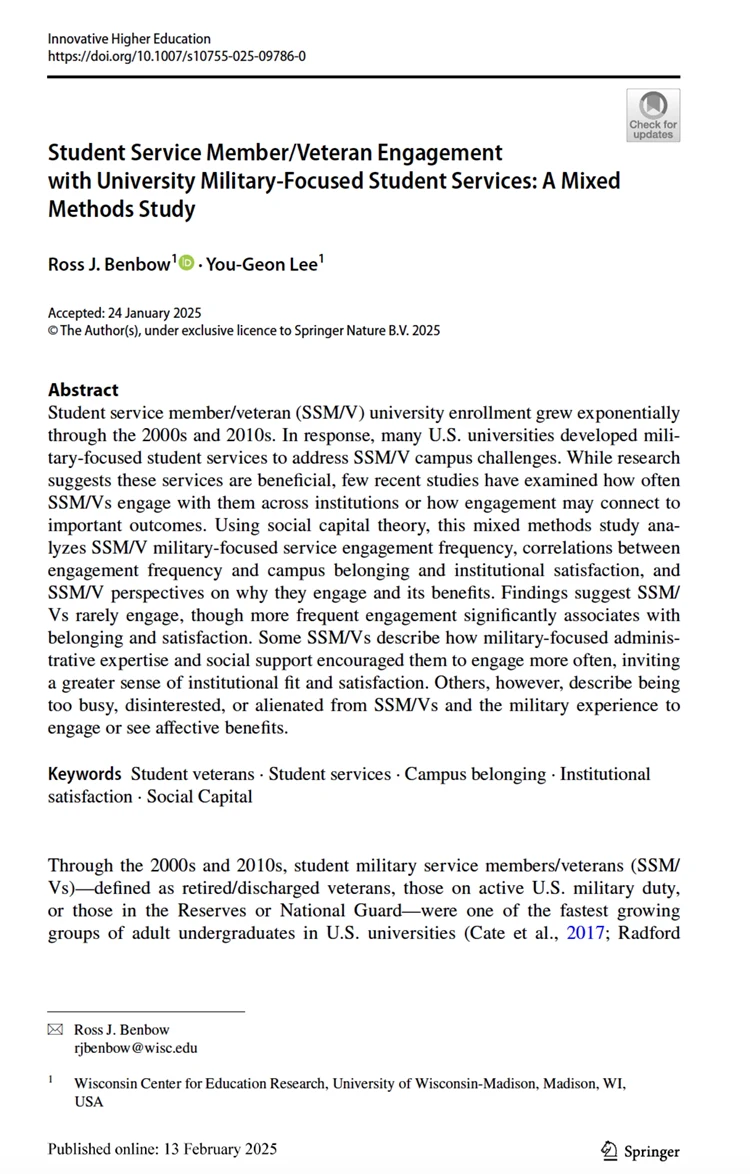
Benbow, R. J. & Lee, Y. G. (2025). Student service member/veteran engagement with university military-focused student services: A mixed methods study. Innovative Higher Education, 50, 1381-1410.
Summary: Student service member/veteran (SSM/V) university enrollment grew exponentially through the 2000s and 2010s. In response, many U.S. universities developed military-focused student services to address SSM/V campus challenges. While research suggests these services are beneficial, few recent studies have examined how often SSM/Vs engage with them across institutions or how engagement may connect to important outcomes. Using social capital theory, this mixed methods study analyzes SSM/V military-focused service engagement frequency, correlations between engagement frequency and campus belonging and institutional satisfaction, and SSM/V perspectives on why they engage and its benefits. Findings suggest SSM/Vs rarely engage, though more frequent engagement significantly associates with belonging and satisfaction. Some SSM/Vs describe how military-focused administrative expertise and social support encouraged them to engage more often, inviting a greater sense of institutional fit and satisfaction. Others, however, describe being too busy, disinterested, or alienated from SSM/Vs and the military experience to engage or see affective benefits.
Benbow, R. J. & Lee, Y. G. (2022). Exploring student service member/veteran social support and campus belonging in university STEMM fields. The Journal of College Student Development, 64(6), 593-610.
Summary: Supported by considerable public investment through post-9/11 higher education benefits, student military service members/veterans (SSM/Vs) have been one of the fastest-growing groups of nontraditional students in American universities in recent years. Despite their increased numbers and potential to diversify science, technology, engineering, mathematics, and medical (STEMM) fields, little research has explored SSM/V academic development and success across university STEMM contexts. This mixed methods study used social capital theory to explore links between STEMM SSM/V social support and a sense of campus belonging—shown to be important to achievement among traditionally marginalized college students—within 4-year campus communities. Social network analyses of surveys indicated that larger SSM/V support networks, including on- and off-campus social ties as well as student and university educator ties, positively correlated with campus belonging. Social support networks with military ties, traditionally seen to benefit SSM/V college integration, did not correlate. Interview responses suggested that while belonging can be discouraged among SSM/Vs by military-associated STEMM imposter feelings, it is fostered through student friendship, faculty care, and veteran-focused campus support. Results underscored the importance of authentic interaction as well as purposeful efforts to bring SSM/Vs together with fellow students, educators, and staff.